
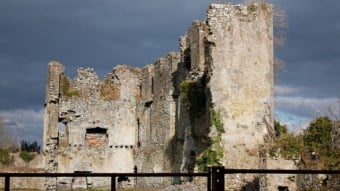
It is private property and therefore not accessible to the public; however, it the ruins make for a striking view against a rural backdrop.
Rathcline Castle comprises fortified buildings from several different periods, evidence of the area’s rich history.
The buildings include a tower house and an enclosed bawn or bailey. There is also a 17th-century fortified manor house, which was later remodelled.
The site was the residence of the O’Quinn family, known as the ‘Lords of Rathcline’ in the early medieval period. In the 14th or 15th century, they built the tower house. Only a portion of the southern and eastern walls have survived, along with some decorated stonework and a double-garderobe, which hints at the stateliness of the medieval castle.
By the 16th century, the castle was in the hands of the O’Farrell clan. In 1627, however, it was granted to Sir Thomas Dutton. Dutton built a fortified manor against its northern wall.
Around 1667, remodelling by Sir George Lane unified the tower house and manor.
A 17th-century plan of the house survives, which indicates that it had an H-shaped plan. It was described in 1682 by Nicholas Dowdall as ‘a very noble and spacious house…being very pleasant and well improved with orchards, gardens, fishponds and a deer park’.
The grandeur of its interior is described by a household inventory dating from 1688, which lists the various rooms: ‘a Damask room, a dining-room, two drawing-rooms, My Lord’s dressing-room, parlour, parlour closet, Castle room and room adjoining, My Lady’s closet, Red room, room above Damask room, Madame Lane’s room and room adjoining, the Nurseries, the Lobby, butler’s garret, cook’s garret, and four other garrets’.
By the year 1800, Rathcline Castle was unfortunately largely derelict due to having been ‘dismantled by Cromwell, and finally burnt and reduced to its present ruinous state, in the wars of King James’.
The impressive bawn wall enclosed the castle complex and has square towers at the corners. An 18th-century painting by Daniel Grose indicates that the tops of the walls may have had battlements, adding to their defensive appearance.
The southern gatehouse was the main entrance into the bawn in the late 17th century. Decorated in a Classical style and dated 1667, it had an armorial plaque bearing the Lane family coat of arms, but it has since been removed.
A formal walled garden adjoined the east side of the bawn and had angle-towers. A fish-pond was located further east, and is now in a field surrounded by trees, and there was an old orchard further south.